
Basics of Fiber Optics and Data Center Cabling
Basics of Fiber Optics and Data Center Cabling refers to the fundamental concepts and practices involved in transmitting data using optical fibers and organizing network cabling within data centers.
- Fiber Optics: A technology that uses thin strands of glass or plastic (optical fibers) to transmit data as light signals over long distances at high speed and with minimal loss.
- Data Center Cabling: The structured system of cables (including fiber and copper), connectors, and hardware used to connect servers, storage systems, and networking equipment inside a data center efficiently and reliably.
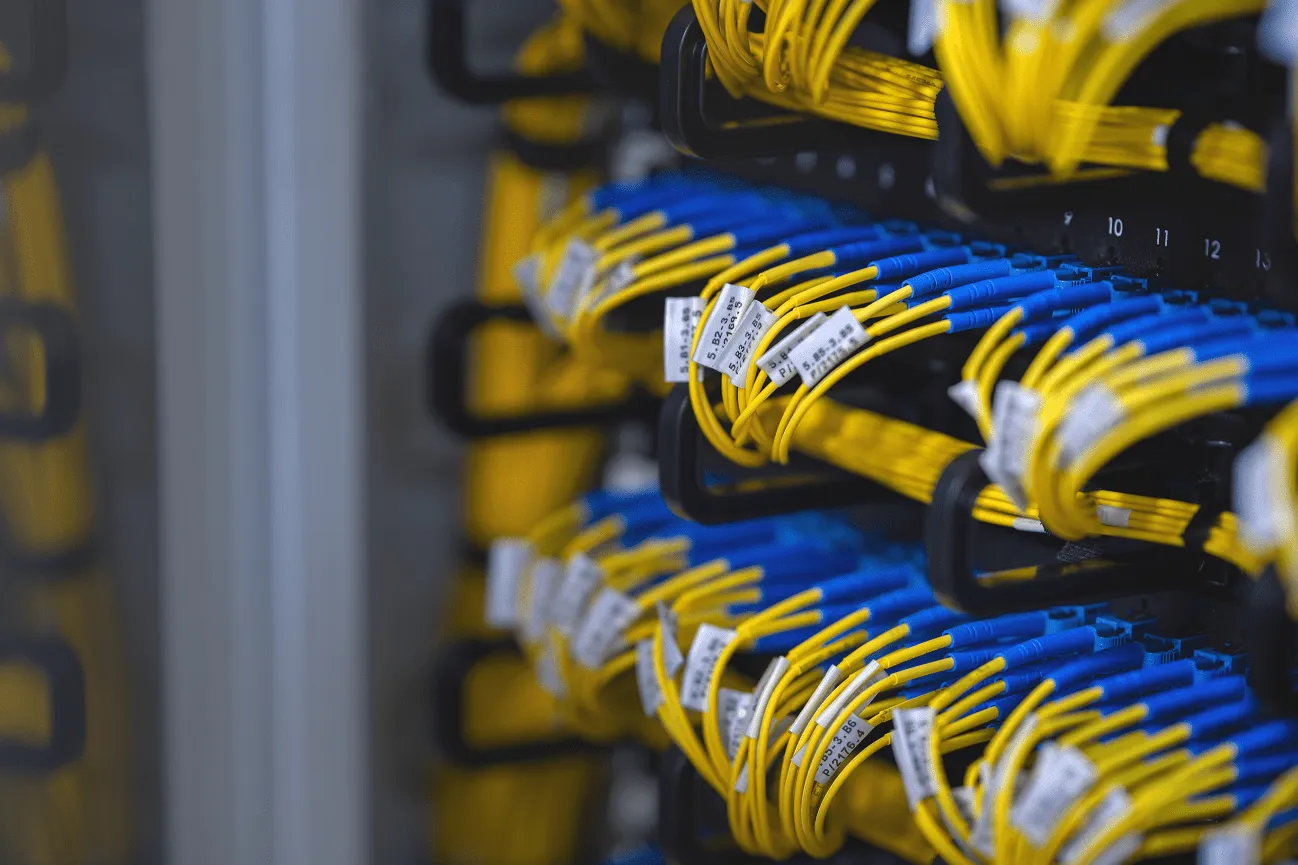
- Part 1 :Basics of Fiber Optics (The Foundation)
- Part 2: Data Centre Cabling
Module 1 & 2 Combined: Fiber Physics, Safety & Cable Architecture (≈ 2.5 hours)
Objectives: Understand how light travels in fiber, differentiate fiber/cable types, and apply critical safety protocols.
Key Topics (Condensed):
- Light Propagation Basics: Total Internal Reflection (TIR), refractive index, attenuation (absorption, scattering, bending), dispersion overview. SMF vs. MMF: core sizes, wavelengths (850/1300 nm MMF; 1310/1550 nm SMF), applications (long-haul vs. short-reach), pros/cons.
- Laser & Fiber Safety: Invisible IR laser hazards (Class 1–4), eye/skin protection, PPE (goggles, gloves), handling glass shards, chemical safety (alcohol), emergency procedures. Always treat fiber as “live” until verified.
- Cable Architecture: Basic construction (core/cladding/buffer/strength members/jacket).
- Tight-Buffered: Flexible, indoor/premises use, easy termination.
- Loose-Tube: Gel or dry tubes for outdoor/OSP protection against moisture/temperature.
- Breakout: Rugged, individual fiber access for direct connectorization. Color coding (TIA-598), bend-insensitive fibers, indoor/outdoor ratings, jacket types.
Hands-On Activities:
- Identify and dissect sample cables (tight-buffer, loose-tube, breakout).
- Measure minimum bend radius; practice safe jacket stripping.
- Laser safety demo + PPE usage.
Assessment: Quick group quiz + cable identification.
Transition Break: 10–15 minutes.
Mid-Morning to Early Afternoon: Practical Skills (≈ 3–3.5 hours)
Module 3: Precision Splicing (≈ 1.5–2 hours – Heavy Hands-On Focus)
Objectives: Gain practical skills in fiber preparation and joining techniques for low-loss connections.
Key Topics (Condensed):
- Why splice? (repairs, pigtails, cable joining). Target losses: <0.1–0.2 dB fusion; higher for mechanical.
- Fiber Preparation: Stripping, precision cleaving (90° end-face), cleaning.
- Mechanical Splicing: Quick V-groove or sleeve method with index gel – ideal for emergencies/repairs.
- Fusion Splicing: Core alignment basics, arc fusion process, heat-shrink protection. Common issues (bad cleave, dirt, misalignment).
Hands-On Activities (Priority: Each participant gets multiple attempts):
- Strip, cleave, and inspect fiber ends (use microscope/VFL).
- Perform 2–3 mechanical splices.
- Demo + supervised fusion splices (prepare, align, splice SMF pair, protect splice). Aim for acceptable loss.
- Place splices in a basic tray/closure.
Assessment: Visual inspection of cleaves + measured splice loss check.
Lunch Break (45–60 minutes)
Afternoon Session: Testing & Application (≈ 2.5–3 hours)
Module 4: Testing & Troubleshooting (≈ 2 hours – Heavy Hands-On)
Objectives: Learn to verify link performance and diagnose common faults using standard tools.
Key Topics (Condensed):
- LSPM (Light Source + Power Meter): Insertion loss testing (Tier 1). Reference methods, loss budget calculation, bidirectional testing. Wavelength-specific checks.
- OTDR Basics: “Radar for fiber” – trace interpretation: length, events (connectors, splices, bends, breaks), attenuation (dB/km), reflectance. Use of launch/receive cables to avoid dead zones.
- Troubleshooting: Dirty connectors, macrobends, bad splices, breaks. Use VFL for quick fault location. Connector inspection & cleaning (IEC standards). Common faults simulation.
Hands-On Activities:
- Set reference and measure end-to-end loss on a test link using LSPM.
- Acquire and analyze simple OTDR traces: identify events, measure splice/connector loss.
- Troubleshoot simulated faults (dirty connector, bend, open fiber) using VFL + OTDR + power meter combo.
- Full basic link characterization: test a short assembled link and document results.
Assessment: Practical station – successfully test/troubleshoot a sample link.
Closing (30–45 minutes)
- Capstone Exercise: Quick build-test-troubleshoot of a mini fiber link (splice + connectors + test).
- Review key takeaways, Q&A, common field mistakes.
- Post-assessment quiz + course feedback.
- Certificate of Completion issued (with note on one-day condensed format).
Morning Session: High-Density Connectivity & Architectures (≈ 3.5 hours)
Module 5 & 6 Combined: High-Density Connectivity + Data Center Architectures (≈ 2.5–3 hours)
Objectives: Master MPO/MTP connectors for high-density environments and understand common data center cabling topologies.
Key Topics (Condensed):
- MPO/MTP Connectors: 12/16/24-fiber configurations, male/female (pinned/unpinned), low-loss vs. standard. Assembly basics and field termination awareness.
- Polarity Types (A, B, C):
- Type A (Straight-through): Key up/down, 1-to-1 mapping. Common with cassettes for duplex applications.
- Type B (Reversed/Flipped): Key up both ends, full reversal (Position 1 to 12). Most popular for parallel optics (40G/100G/400G SR4).
- Type C (Pair-wise flip): Flips adjacent pairs. Best for duplex LC but less used in high-speed parallel links. How to select and verify polarity to avoid Tx/Rx mismatches.
- Cleaning Best Practices: Why MPO is highly sensitive to contamination. Use of one-click cleaners, cassette cleaners, inspection scopes (IEC 61300-3-35). Wet/dry methods, inspect before every mate. Common pitfalls in high-density panels.
- Data Center Architectures:
- Leaf-Spine (Spine-Leaf): Modern scalable, non-blocking design. Leaves (ToR) connect servers; Spines provide full mesh interconnects. Advantages: low latency, easy scaling.
- Top-of-Rack (ToR): Switches at the top of each server rack. Short in-rack cables, fiber uplinks to spine. Pros: simplified management, less horizontal cabling. Cons: more switches.
- End-of-Row (EoR): Centralized switches at row end. Longer horizontal runs within the row. Pros: fewer switches. Cons: cable bulk and management challenges. Comparison of ToR vs. EoR in leaf-spine deployments.
Hands-On Activities:
- Identify and inspect MPO connectors (male/female, polarity markings).
- Practice MPO cleaning and end-face inspection using scopes.
- Connect sample MPO trunks/patch cords with different polarities and verify continuity (using VFL or basic power meter).
- Group discussion: Match architectures to scenarios (high-density vs. cost-sensitive DC).
Short Break (10–15 min)
Mid to Late Morning / Early Afternoon: Practical Management & Migration (≈ 3–3.5 hours)
Module 7: Cable Management (≈ 1–1.5 hours)
Objectives: Learn to maintain proper airflow, respect bend radii, and apply professional labeling in dense racks.
Key Topics (Condensed):
- Airflow Management: Hot/cold aisle containment, avoiding cable blockage in front/rear of racks. Use of vertical/horizontal managers, finger ducts, and slack management.
- Bend Radius in Tight Racks: Fiber minimum bend radius (typically 10x cable diameter; tighter for bend-insensitive G.657). Risks of macrobends causing signal loss. Tools and techniques for routing in high-density panels.
- Labeling Standards (TIA-606-C): Hierarchical identification for racks, panels, ports, cables, and pathways. Labels must be legible, durable, placed at both ends (within ~300 mm of termination). Unique identifiers, color coding, and documentation best practices for data centers.
Hands-On Activities:
- Route sample MPO cables in a mock high-density rack while maintaining bend radius and airflow.
- Practice proper cable dressing, velcro ties (not overtightening), and slack storage.
- Create and apply TIA-606-C style labels on cables, ports, and racks.
Lunch Break (45–60 minutes)
Module 8: Migration Paths (≈ 1.5 hours)
Objectives: Understand how to transition existing infrastructure to higher speeds without full rip-and-replace.
Key Topics (Condensed):
- From 10G to 40G/100G/400G: Shift from duplex LC (10G SR) to parallel optics using MPO (SR4 for 40/100G).
- Multimode Focus (OM3/OM4/OM5): Reach limits (e.g., OM4: 100–150 m for 100G SR4). Use of Base-8 or Base-12 MPO for easy upgrades.
- Key Migration Techniques:
- Breakout cables/cassettes (e.g., 1x100G to 4x25G or 400G to 4x100G).
- Polarity and pin mapping consistency.
- SWDM (Short Wavelength Division Multiplexing) for reusing duplex fiber.
- Singlemode options (PSM4, DR4, FR4) for longer reaches or future-proofing.
- Practical strategies: Incremental upgrades using existing trunks, testing during migration, minimizing downtime.
Hands-On Activities:
- Demonstrate breakout using MPO-LC cassettes or harnesses.
- Test a simple migration link (e.g., 10G duplex to 40G/100G MPO) with power meter or OTDR basics.
- Group exercise: Plan a migration path for a given rack setup (ToR leaf to spine at 400G).
Closing Session (30–45 minutes)
- Capstone Exercise: Build a mini high-density link — select correct MPO polarity, clean/inspect, route with proper bend radius/airflow, label per TIA-606-C, and perform basic loss test.
- Key Takeaways & Common Field Mistakes (polarity errors, contamination, airflow blockage, poor labeling).
- Q&A, post-assessment quiz, course feedback.
- Certificate of Completion (noting the one-day condensed format).
Key Adjustments from Multi-Day Version
- Theory is streamlined to essentials with heavy use of visuals and real samples.
- Hands-on priority: Participants spend significant time on MPO cleaning/inspection, polarity handling, cable routing, and labeling.
- Reduced depth on advanced topics (e.g., no deep transceiver internals or full 800G planning).
- Emphasis on practical data center realities: density, airflow, quick troubleshooting, and future-proof migration.
Expected Outcomes: By the end of the day, participants will be able to:
- Confidently handle, clean, inspect, and connect MPO/MTP links with correct polarity.
- Differentiate and apply ToR, EoR, and Leaf-Spine designs.
- Manage cables professionally in high-density environments while meeting TIA-606-C labeling.
Plan basic migration steps from 10G to 40G/100G/400G.
FAQ's
Fiber optics basics include understanding light propagation through Total Internal Reflection (TIR), fiber types like Single Mode Fiber (SMF) and Multimode Fiber (MMF), attenuation, dispersion, and safety practices when handling optical fibers.
Single Mode Fiber (SMF) is used for long-distance communication with smaller core size and wavelengths like 1310/1550 nm, while Multimode Fiber (MMF) is used for short distances with larger core size and wavelengths like 850/1300 nm.
The main types include tight-buffered cables (for indoor use), loose-tube cables (for outdoor protection), and breakout cables (rugged cables for direct connectorization).
Fiber optic splicing is the process of joining two fiber cables using methods like fusion splicing (low loss) or mechanical splicing (quick repairs).
Common tools include Optical Time Domain Reflectometer (OTDR), Light Source and Power Meter (LSPM), and Visual Fault Locator (VFL).
MPO/MTP connectors are high-density fiber connectors that support multiple fibers (12/24 fibers) in a single interface, commonly used in high-speed data center networks.
There are three polarity types:
- Type A (Straight-through)
- Type B (Reversed)
- Type C (Pair-wise flip)
These ensure proper signal transmission between transmitter (Tx) and receiver (Rx).
Common architectures include:
- Leaf-Spine architecture
- Top-of-Rack (ToR)
- End-of-Row (EoR)